
At a glance
Vietnam has nearly 100 million inhabitants, a literacy rate of 96%, and 17% of the population in the core migration age group of 17 to 25 years. At the same time, the country has a higher education system in which 17% of graduates are unemployed and up to 60% work in jobs unrelated to their field of study. The domestic return on education is collapsing, and ambitious young people are looking for alternatives that actually deliver career outcomes.
The dual vocational training system in Germany is one of the most compelling answers. It offers no tuition fees, a monthly salary during training, a recognized qualification, and a clear path to permanent residence. For Vietnamese families weighing the cost of a domestic university education against labor market uncertainty, the German training path represents a fundamentally safer investment.
This is not a temporary trend. Vietnam’s demographic window is closing by 2038. For German employers facing structural labor shortages, the next decade presents a unique opportunity to build reliable talent pipelines from one of the world’s most motivated and trainable workforces.
Vietnam’s education system produces talent it cannot employ
Vietnam has invested heavily in basic education. The national literacy rate stands at 96%, the average years of schooling has risen to 9.6 years, and the country consistently produces young people with solid academic foundations and a genuine drive to succeed. The raw talent is there.
The problem is what comes next. The higher education system is widely criticized for outdated curricula, theoretical orientation, and a lack of practical workplace skills. Only 26% of the population have any kind of technical or vocational qualification. The result is a generation of graduates who are well educated on paper, but insufficiently prepared for the labor market.
The numbers make this painfully clear. Unemployment among university graduates is about 17%, more than seven times the national unemployment rate of 2.3%. Up to 60% of graduates end up in jobs unrelated to their field of study. At the same time, 41% of Vietnamese employers report that they cannot find enough qualified candidates. The system produces the wrong skills for the wrong jobs, and everyone knows it.

[Figure 1: Vietnam's Education Paradox]
Why families choose paths abroad
The decision to pursue education or work abroad is not impulsive. It is a calculated family investment, driven by a sober assessment of domestic risk versus international opportunity.
Research shows that 58.6% of potential Vietnamese migrants cite international work experience as their main motivation, viewing it as a necessary building block for career development whether they return or settle abroad. Another 17.2% cite higher wages directly. Vietnamese employers themselves reinforce this logic by actively preferring candidates with international experience, foreign language skills, and the resilience that comes with life abroad.
For families, the math is simple. A Vietnamese university degree costs up to $1,000 per semester and is rising as institutions shift from public to private funding. Employment outcomes are uncertain at best. By contrast, the German vocational training system charges no tuition and pays a monthly salary of 900 to 1,300 euros during training. The graduate receives a recognized qualification, almost guaranteed employment, and a clear path to permanent residence. If the domestic option carries a 17% unemployment risk and the international option carries a near-zero risk, the decision makes itself.
The cultural context also matters. The concept of filial piety means that parents and extended family play a central role in educational decisions. They are not only emotionally invested but also financially invested, and they evaluate paths abroad primarily in terms of risk minimization and guaranteed return. The German vocational model, with its combination of no tuition, guaranteed income, and residence security, directly addresses every concern a Vietnamese family has when sending a child abroad.
Germany has a structural advantage that most employers do not understand
Among the major destination countries competing for Vietnamese talent, Germany holds a uniquely strong position. This is not just about the quality of training. It is about the policy framework around it.
The traditional destinations for Vietnamese students are Japan (43,275 students in 2021) and South Korea (nearly 25,000). Both countries offer geographic proximity and established labor channels. However, both maintain restrictive, temporary visa regimes, where the prospects for permanent settlement are low. Vietnamese students and families are pragmatic. They respond quickly to policy conditions, and in recent years there have been rapid shifts in enrollment as students move toward destinations that offer the best combination of quality, affordability, and long-term security.
Germany's competitive advantage comes from three structural strengths that most Asian destinations cannot offer:
No tuition and paid training: Trainees receive 900 to 1,300 euros per month during their three-year program, eliminating the financial risk that shapes the Vietnamese educational experience at home.
Recognized qualifications: A German vocational qualification is internationally recognized and leads directly to employment in the German labor market.
Residence security: Germany offers an 18-month job-seeker visa after graduation with a clear and well-documented path to permanent residence. This is the single strongest differentiator for Vietnamese families.
The flow of Vietnamese students is highly sensitive to policy signals. The countries that offer the clearest and most secure post-study pathways are the ones that attract and retain the most committed talent. Germany's policy framework does exactly that, and it is a strategic advantage from which German employers benefit whether they realize it or not.

[Figure 2: Germany vs. Asian target countries: policy comparison]
The demographic window is closing
Vietnam's current demographic profile is a key part of what makes this talent pipeline possible. With 68% of the population of working age and around 1.2 million young people entering the labor market each year, the country offers a deep pool of motivated, trainable candidates.
However, this window is temporary. Forecasts show that Vietnam will end its demographic dividend by 2038. After that, the share of dependents relative to working people will increase, and the Vietnamese government may begin to restrict labor and student outflows in order to stabilize its own domestic workforce.
For German employers, the implication is clear: the next 10 to 12 years represent a unique window of opportunity to build reliable, ethical recruitment pipelines from Vietnam. Companies that build these partnerships now will have a structural advantage over those that wait. Once the demographic window closes and the Vietnamese government begins to restrict outflows, building new pipelines from scratch will become significantly more difficult and expensive.

[Figure 3: Vietnam’s demographic window]
Germany’s Healthcare Sector: Where Demand Meets Supply
The alignment between Vietnamese talent and German labor demand is strongest in healthcare. The Federal Statistical Office projects that the number of people in need of care will rise significantly by 2055, with at least 150,000 additional care workers needed by 2040. In 2023 alone, 35,000 care positions remained unfilled nationwide.
Vietnam has an estimated 140,000 to 150,000 care workers, with a population predominantly aged between 20 and 35. The demographic profile matches the demand profile almost exactly. The challenge is not finding willing candidates. It is ensuring that they arrive with the language skills, cultural preparation, and professional readiness to succeed in a heavily regulated German healthcare environment.
Formalized programs such as Triple Win have already shown that this can work at scale. Between 2019 and 2023, the program placed 350 Vietnamese participants into three-year nursing training programs in Germany, with over 90% participant satisfaction. The model is proven. The question is whether Germany will scale it fast enough to meet demand.
The Risk That Undermines Everything: Exploitative Intermediaries
Strong demand for migration to Germany has created a shadow industry in Vietnam of exploitative labor brokers and study-abroad agencies. These intermediaries charge excessive fees, provide misleading information about salaries and living conditions, and in the worst cases channel vulnerable young people into irregular migration routes that expose them to exploitation.
Some intermediaries simply make false claims, such as the possibility of sending home $4,000 per month on a trainee salary. Even highly qualified graduates of top German universities cannot reach those sums. The reality is that trainees earn 900 to 1,300 euros before tax per month, which provides genuine financial stability, but is far from the promises being sold.
For German employers, this is directly relevant. If candidates arrive with unrealistic expectations shaped by dishonest intermediaries, the likelihood of an early dropout rises dramatically. The antidote is to work exclusively with recruitment partners who provide genuine language preparation, transparent disclosure of costs, and realistic expectations before candidates leave Vietnam.
What This Means for German Employers
The structural forces driving Vietnamese talent to Germany are strong, well documented, and time-limited. For employers facing chronic labor shortages, the following matter most:
The talent pool is real and deep: Vietnam produces highly educated, motivated young people with strong academic foundations. The gap lies in vocational skills, which is exactly what the German training system was designed for.
Motivation is structural, not just aspiration: Vietnamese families make calculated investment decisions based on the failure of domestic education. Candidates who come through training pathways are committed because the alternative was worse, not because they are chasing a dream.
The demographic window is closing: The current volume of available talent will not last forever. Companies that build ethical recruitment partnerships over the next decade will have a lasting advantage.
Germany’s policy framework is a competitive weapon: The combination of free training, paid apprenticeship positions, and a clear path to residency gives Germany a structural advantage over any major Asian destination country.
Process quality determines the outcome: Ethical recruitment, genuine language preparation, and post-placement support are not nice-to-haves. They are the difference between a long-term team member and an expensive early dropout.

[Figure 4: The Vietnamese migration decision: push and pull factors]
About this report
This is the third in a series of research publications by Alma Recruiting, based on publicly available data, government reports, academic research, and bilateral program evaluations, to provide German employers with evidence-based insights into international recruitment.
If you are exploring international recruitment or evaluating Vietnam as a talent source for the first time, we would be happy to speak with you.
Sources
Wikipedia: Education in Vietnam (2024)
Global Student Living: Country profile Vietnam (2024)
IZA World of Labor: Higher education and job prospects in Vietnam
British Council: Employability of Vietnamese graduates
NGO Centre Vietnam: Report on average years of schooling (2024)
Collab International: Why Vietnamese students choose Europe
ERIC: Motivations for studying abroad and immigration intentions
Migration Policy Institute: Immigration systems in Japan and Korea
GIZ: Triple Win nursing staff for Germany
ILO: Youth employment in Vietnam
IOM Vietnam: International migration and returnees
PRB: Population and development in Vietnam
Migration Policy Institute: From humanitarian to economic migration
Rosa-Luxemburg-Stiftung: Between agency and exploitation
BAT Germany: Vietnamese care worker solutions
AHK Vietnam: Dual vocational training program overview
GIZ/BA: Triple Win program documentation
Friedrich-Ebert-Stiftung: Labour migration from Vietnam to Germany
VnExpress: Reality check on training salaries abroad
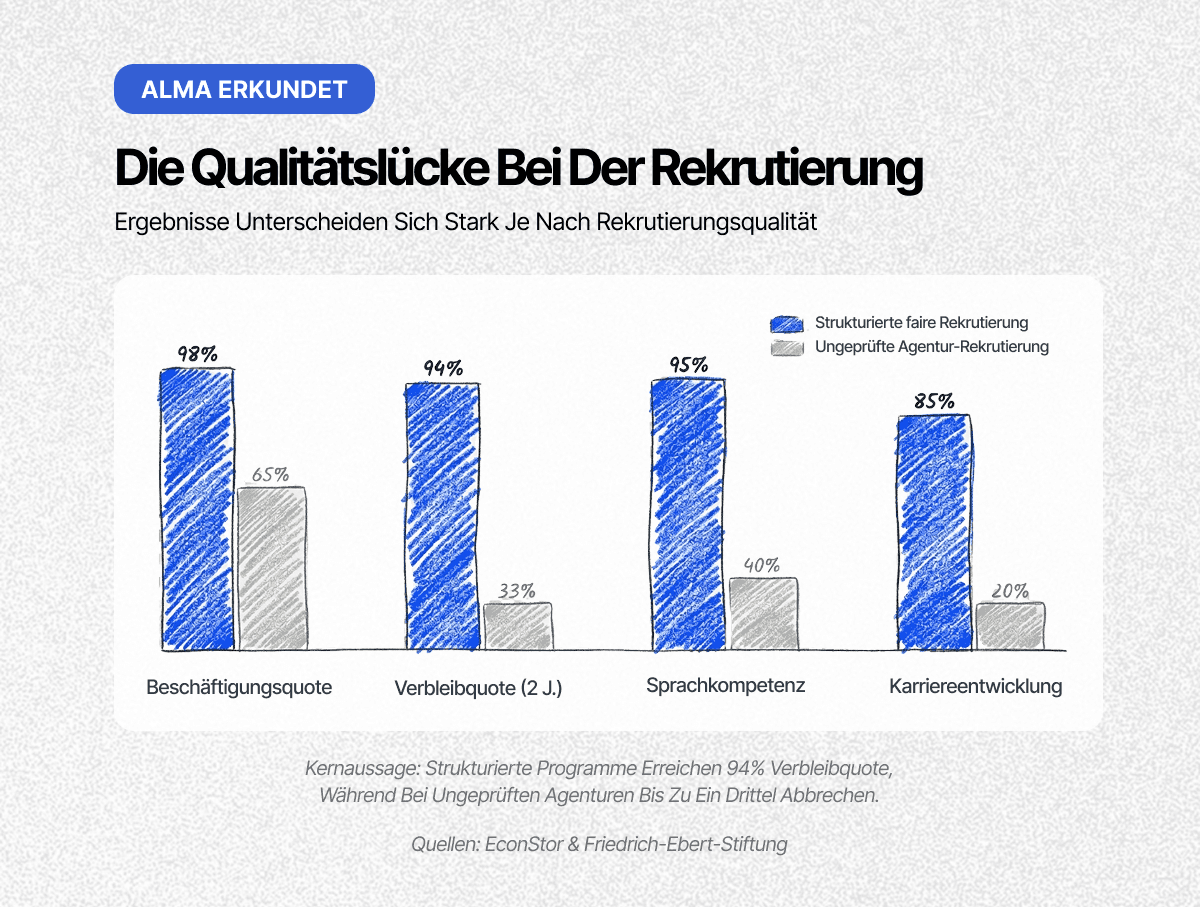
Illustrativer Vergleich der Ergebnisse strukturierter gegenüber ungeprüfter Rekrutierung, auf Basis von Mustern, die EconStor und die Friedrich-Ebert-Stiftung berichten. Die Werte sind repräsentativ und stammen nicht aus einem einzelnen Datensatz.
Strukturierte Programme und ungeprüfte Vermittler bringen deutlich unterschiedliche Ergebnisse hervor, über Beschäftigung, Verbleib nach zwei Jahren, Sprachreife und berufliche Entwicklung hinweg. Die Merkmale der ersteren sind durchgängig und beobachtbar:
Unabhängige Überprüfung der Sprachkenntnisse, festgestellt durch Tests und nicht allein auf Grundlage eines Zertifikats.
Vom Arbeitgeber getragene, transparente Kostenstrukturen, bei denen die vollen Kosten offengelegt und von der Partei getragen werden, die von der Vermittlung profitiert.
Vorbereitung vor der Ausreise, die deutsche Arbeitskultur und die konkreten Anforderungen der Stelle abdeckt.
Begleitung nach der Vermittlung, die über die Vertragsunterzeichnung hinaus fortbesteht.
Belegte Verbleibquoten aus früheren Vermittlungen, einsehbar zur Prüfung.
Dies sind keine Vorlieben, sondern Kostenpunkte, und sie sind die unmittelbaren Entsprechungen der oben gezeigten Ergebnisunterschiede. Ein Arbeitgeber, der einen Rekrutierungspartner auswählt, entscheidet damit faktisch darüber, ob diese Leistungen erbracht werden.
Fazit
Die hier zusammengetragenen Belege weisen in eine einheitliche Richtung. Der deutsche Bedarf an Ausbildungskräften konzentriert sich auf bestimmte Branchen, und vietnamesische Auszubildende treten in eben diese Branchen in eng entsprechenden Anteilen ein. Ihre Bilanz, sowohl im vietnamesischen Bildungssystem als auch innerhalb deutscher Institutionen, ist stärker als die vergleichbarer Gruppen. Das Volumen steigt, von 4.400 neuen Verträgen im Jahr 2023 auf 7.100 im Jahr 2024 [1] und geschätzte 10.000 im Jahr 2025 [28].
Die Fehlschläge, die die öffentliche Berichterstattung beherrschen, sind real, lassen sich aber nicht gut mit den Eigenschaften der Bewerber erklären. Besser erklären lassen sie sich mit der Struktur des Marktes, der sie rekrutiert: fragmentiert, unreguliert und von den Bewerbern statt von den Arbeitgebern finanziert, mit der absehbaren Folge, dass genau die Leistungen, die über das Gelingen einer Vermittlung entscheiden, unterfinanziert sind oder fehlen.
Das ist ein strukturelles Problem, und strukturelle Probleme haben strukturelle Lösungen: Mindeststandards dafür, wer als Vermittler tätig sein darf, Transparenz darüber, was Bewerbern in Rechnung gestellt wird, und die Verlagerung der Rekrutierungskosten auf die Arbeitgeber, die von der Vermittlung profitieren. Für deutsche Arbeitgeber ist die praktische Schlussfolgerung enger gefasst. Das Fehlen einer Rechnung bedeutet nicht das Fehlen von Kosten; es bedeutet, dass die Kosten an anderer Stelle anfallen, und die Belege legen nahe, dass der Ort, an dem sie anfallen, darüber entscheidet, ob die Vermittlung hält.
Über diesen Bericht
Dies ist Teil der Forschungsreihe von Alma Recruiting, die öffentliche Daten, staatliche und wissenschaftliche Forschung sowie Almas eigene Markterfahrung zusammenführt, um deutschen Arbeitgebern einen evidenzbasierten Blick auf faire internationale Rekrutierung zu geben. Wo eine Zahl auf Almas unmittelbaren Markt- oder Konsulatskontakten beruht und nicht auf einer veröffentlichten Quelle, ist dies im Text kenntlich gemacht.
Quellen
Asia News Network / The Straits Times: „For Vietnam’s young, favoured Germany vocational path is fraught with greedy middlemen“ (neue Ausbildungsverträge; VISLA zur schwachen Regulierung). https://asianews.network/for-vietnams-young-favoured-germany-vocational-path-is-fraught-with-greedy-middlemen/
VnExpress International: „80% of Vietnamese students in Germany on vocational training“ (Zahlen zu Studierenden, Branchen). https://e.vnexpress.net/news/news/education/80-of-vietnamese-students-in-germany-on-vocational-training-4751953.html
OANA News: „Vietnam–Germany labour cooperation“ (Demografie, Partnerschaft). https://www.oananews.org/node/710009
IZA World of Labor: „University education may lead to worse job prospects in Vietnam“ (Arbeitslosigkeit von Hochschulabsolventen). https://wol.iza.org/news/university-education-may-lead-to-worse-job-prospects-in-vietnam
British Council, Opportunities Insight: „Graduate Employability for Vietnamese students“ (Anteil fachfremd Beschäftigter). https://opportunities-insight.britishcouncil.org/short-articles/news/graduate-employability-vietnamese-students
ScienceDirect: „Overeducation and wage penalties among young university graduates in Vietnam“ (Lohnabschlag bei Fehlqualifikation). https://www.sciencedirect.com/science/article/abs/pii/S0883035525003374
VnExpress International: „I make just $220 a month as a ride-hailing driver 5 years after graduating“ (Einstiegsgehälter im Vergleich zu Gig-Arbeit). https://e.vnexpress.net/news/tech/i-make-just-220-a-month-as-ride-hailing-driver-5-years-after-graduating-with-business-degree-4962705.html
Vietnam Law Magazine: „Japan works to curb charges Vietnamese trainees pay to brokers“ (Arbeitsmigrationskorridore und Vermittlungsgebühren). https://vietnamlawmagazine.vn/japan-works-to-curb-charges-vietnamese-trainees-pay-to-brokers-48841.html
deutschland.de (Portal des Auswärtigen Amts): Abschluss- und Beschäftigungsquoten der dualen Ausbildung. https://www.deutschland.de/en/topic/business/germany-work-and-career-dual-vocational-training
OECD, PISA 2022, Länderbericht: Vietnam (Schülerleistungen). https://www.oecd.org/en/publications/pisa-2022-results-volume-i-and-ii-country-notes_ed6fbcc5-en/viet-nam_a727c3a8-en.html
IZA Discussion Paper 13066: „Vietnam’s Extraordinary Performance in the PISA Assessment“ (der „Vietnam-Vorteil“). https://docs.iza.org/dp13066.pdf
Journal of Ethnic and Migration Studies: „Vietnamese in West and East Germany“ (Gymnasialbesuch der zweiten Generation). https://www.tandfonline.com/doi/full/10.1080/1369183X.2020.1724418
Springer / Nationales Bildungspanel (NEPS): Forschung zu „Unterbrechung“ statt endgültigem Abbruch in der deutschen Ausbildung. https://link.springer.com/article/10.1007/s11618-023-01151-1
Lost in Europe / RBB: „Vietnamese trainees disappear from Berlin vocational schools“ (private Agenturen; Ruf nach Qualitätskontrolle). https://lostineurope.eu/investigations/vietnamese-trafficking-investigation/vietnamese-trainees-disappear-from-berlin-vocational-schools
Worldcrunch: „Hanoi to Bavaria: Vietnamese Pay the Price to Chase Their German Dream“ (ILO-Position dazu, wer zahlen sollte; Umfang staatlicher Programme). https://worldcrunch.com/business-finance/vietnam-immigration-europe-germany/
VisaGuard Berlin: „Vietnamese trainees: Lessons from the Altenburg scandal“ (freiwillige Gütesiegel; Ruf nach Regulierung). https://www.visaguard.berlin/en/post/vietnamese-trainees-lessons-from-the-altenburg-scandal
Ifo Institut (via Cao Đẳng Viễn Đông): Kennzahlen zum deutschen Fachkräftemangel nach Branche. https://www.viendong.edu.vn/en/germany-desperate-for-labor-vietnamese-students-are-ready-but-afraid-of-the-german-language.html
Stiftung Wissenschaft und Politik (SWP Berlin): „Germany is Looking for Foreign Labour“. https://www.swp-berlin.org/10.18449/2023RP03/
Goethe-Institut Vietnam: Sprachvorbereitung und Ausbildungswege. https://www.goethe.de/ins/vn/en/spr/lad/lud/iht.html
BIBB (Bundesinstitut für Berufsbildung): Datensystem DAZUBI. https://www.bibb.de/de/12129.php
OECD: „Vocational Education and Training Systems in Nine Countries“ (Deutschland). https://www.oecd.org/en/publications/vocational-education-and-training-systems-in-nine-countries_1a86eb6c-en/full-report/vocational-education-and-training-in-germany_dae78944.html
BAT Germany: Überblick zu Bedingungen und Kosten der dualen Ausbildung. https://batgermany.de/what-is-dual-vocational-training/
EconStor: Forschung zur Gewinnung und Bindung von Fachkräften aus dem Ausland. https://www.econstor.eu/bitstream/10419/222921/1/1726039005.pdf
Friedrich-Ebert-Stiftung: Analyse der Arbeitsmigration von Vietnam nach Deutschland. https://library.fes.de/pdf-files/bueros/vietnam/21938.pdf
Bundeskriminalamt (BKA): bundesweite Statistiken, auf die in den Rekrutierungskennzahlen verwiesen wird. https://www.bka.de
Asiatische Entwicklungsbank, Asian Development Outlook (Juli 2026): Prognose, dass Vietnam die am schnellsten wachsende Volkswirtschaft Südostasiens bleibt, 7,2 % (2026), 7,0 % (2027). https://www.adb.org/news/viet-nam-economic-growth-remains-resilient-amid-global-challenges
South China Morning Post: „Vietnamese lead influx of migrants to South Korea as foreign population hits record high“ (Migrationsvolumen; Employment Permit System). https://www.scmp.com/news/asia/east-asia/article/3337158/vietnamese-lead-influx-migrants-south-korea-foreign-population-hits-record-high
Alma Recruiting: Schätzung von rund 10.000 Ausbildungsverträgen für 2025, auf Basis von Berichten des vietnamesischen Konsulats über Almas direkte Beziehung zum Konsulat.