And what employers should know about the risks and opportunities
Alma Recruiting | Research Series | 2026
The key points at a glance
Vietnamese trainees are among the strongest groups in the German vocational training system. 80% of Vietnamese students in Germany complete vocational training. The employment rate after graduation is close to 100%. The retention rate in nursing is the same as that of German colleagues. Monthly salaries range between 2,500 and 4,000 euros.
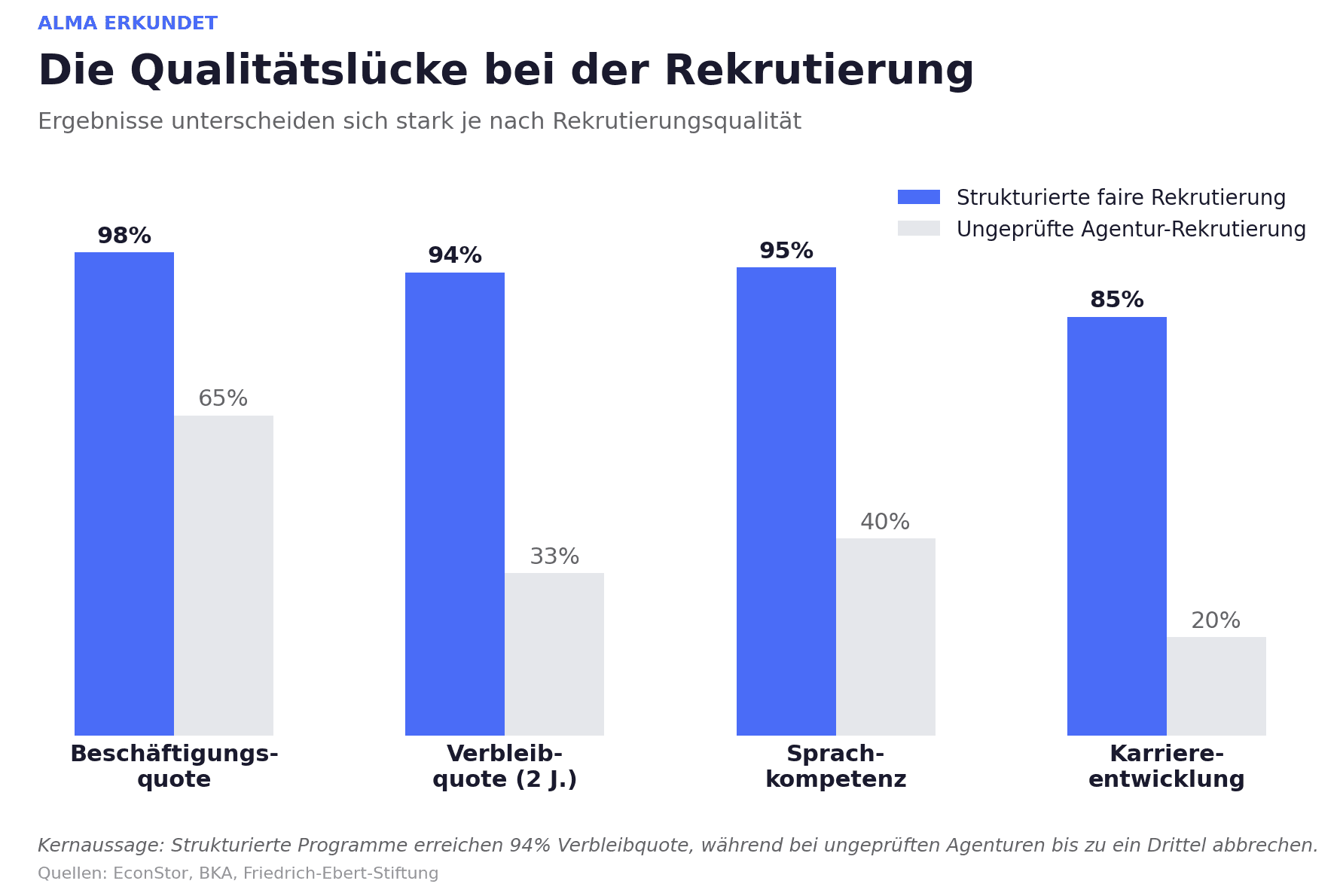
However, this success story has a serious catch. Unregulated agencies in Vietnam charge up to 20,000 euros, issue fake language certificates, and send unprepared trainees into a system they cannot handle. Up to one third of Vietnamese trainees at some Berlin vocational schools have dropped out. Many disappear into the shadow economy.
For German employers, the message is clear: Vietnamese talent delivers excellent results when the recruitment process is carried out properly. If not, everyone bears the costs.
Germany's skilled labor shortage is not going away
Germany's skilled labor shortage is structural, not cyclical. In 2024, 69,400 training positions remained unfilled. The construction sector waits an average of 281 days to fill a single position. In healthcare alone, 1.3 million workers are missing. The country needs an estimated 400,000 qualified immigrants per year to keep the economy running.
The domestic pipeline cannot solve this on its own. EU countries face similar demographic pressure, which limits the available European labor pool. Germany must keep looking further afield, and Vietnam has established itself as one of the strategically most important countries of origin.
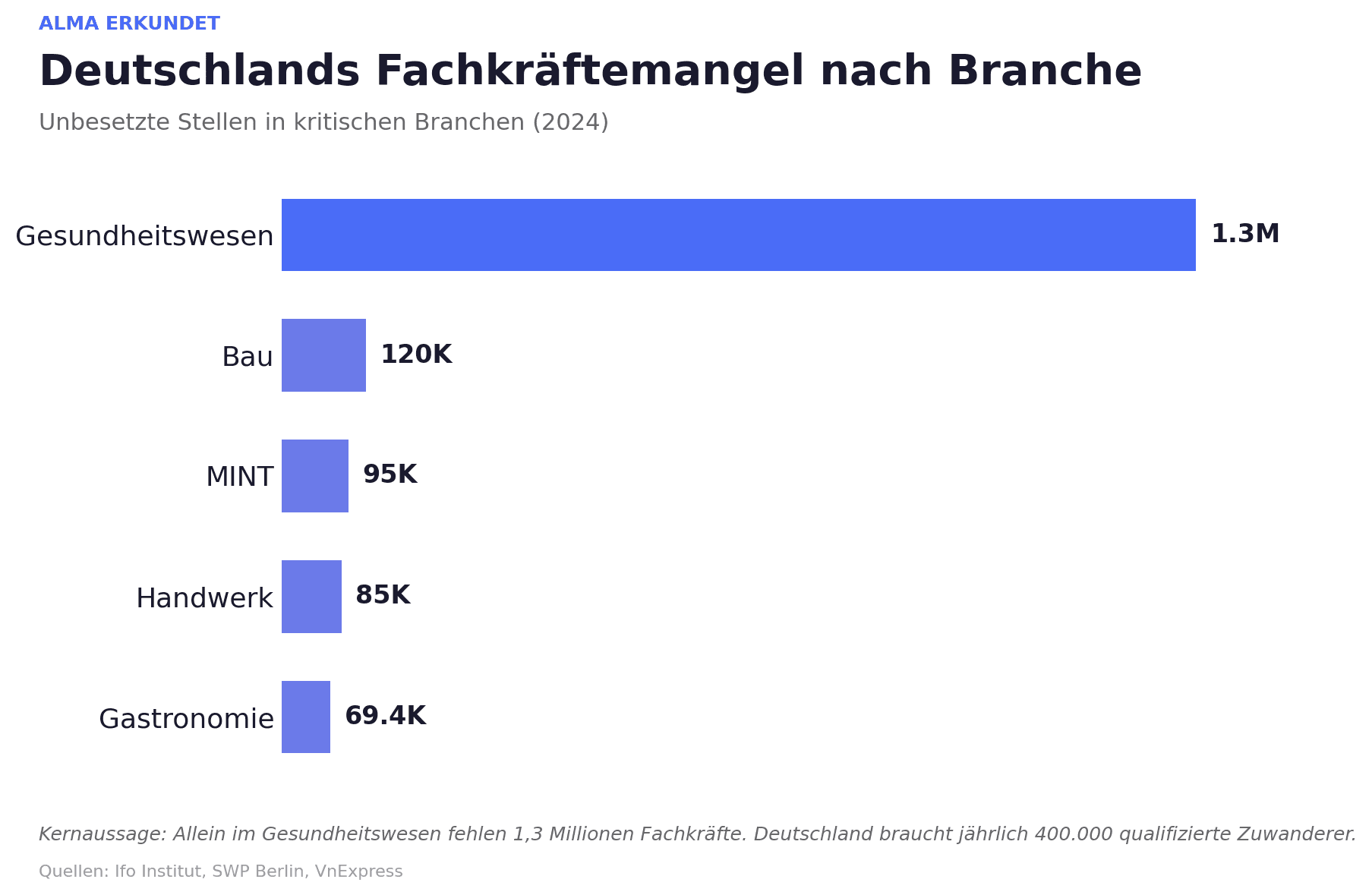
The domestic pipeline alone cannot solve this. EU countries face similar demographic pressure, which limits the available European labor pool. Germany must continue to look farther afield, and Vietnam has emerged as one of the strategically most important countries of origin.
Why Vietnam and why now
Vietnam has 101.8 million inhabitants, 68% of whom are of working age. The country is in a demographic window that will not last forever, and its young workforce is actively seeking international career opportunities. Demand from German companies for Vietnamese talent has grown more strongly than for any other nationality.
In January 2024, both countries formalized a bilateral skilled labor partnership. Vocational training is now one of the official pillars of German-Vietnamese cooperation. This is not a temporary arrangement. The partnership is designed as a long-term human resources cycle in which Vietnamese workers gain skills and experience in Germany and later bring that knowledge back to support Vietnam's development.
For employers, this means access to a reliable, growing talent pipeline supported by government cooperation on both sides.
The numbers: How Vietnamese trainees perform
The data on Vietnamese participation in the German vocational training system is consistently strong.
Metric | Value | Context |
Vietnamese students in Germany | Approx. 7,400 | 30% increase compared to pre-Covid |
Share in vocational training | 80% (approx. 4,000 trainees) | Significantly higher than the share in university studies |
Main industries | Nursing, hospitality, engineering | Directly aligned with Germany's biggest bottlenecks |
Monthly training allowance | 800 to 1,600 euros | Removes the financial burden of student debt |
Monthly salary after graduation | 2,500 to 4,000 euros | At or above the national average |
Employment rate after graduation | Nearly 100% | Almost all graduates find work immediately |
Retention rate in nursing | Same as German staff | If B2 language standards are met |
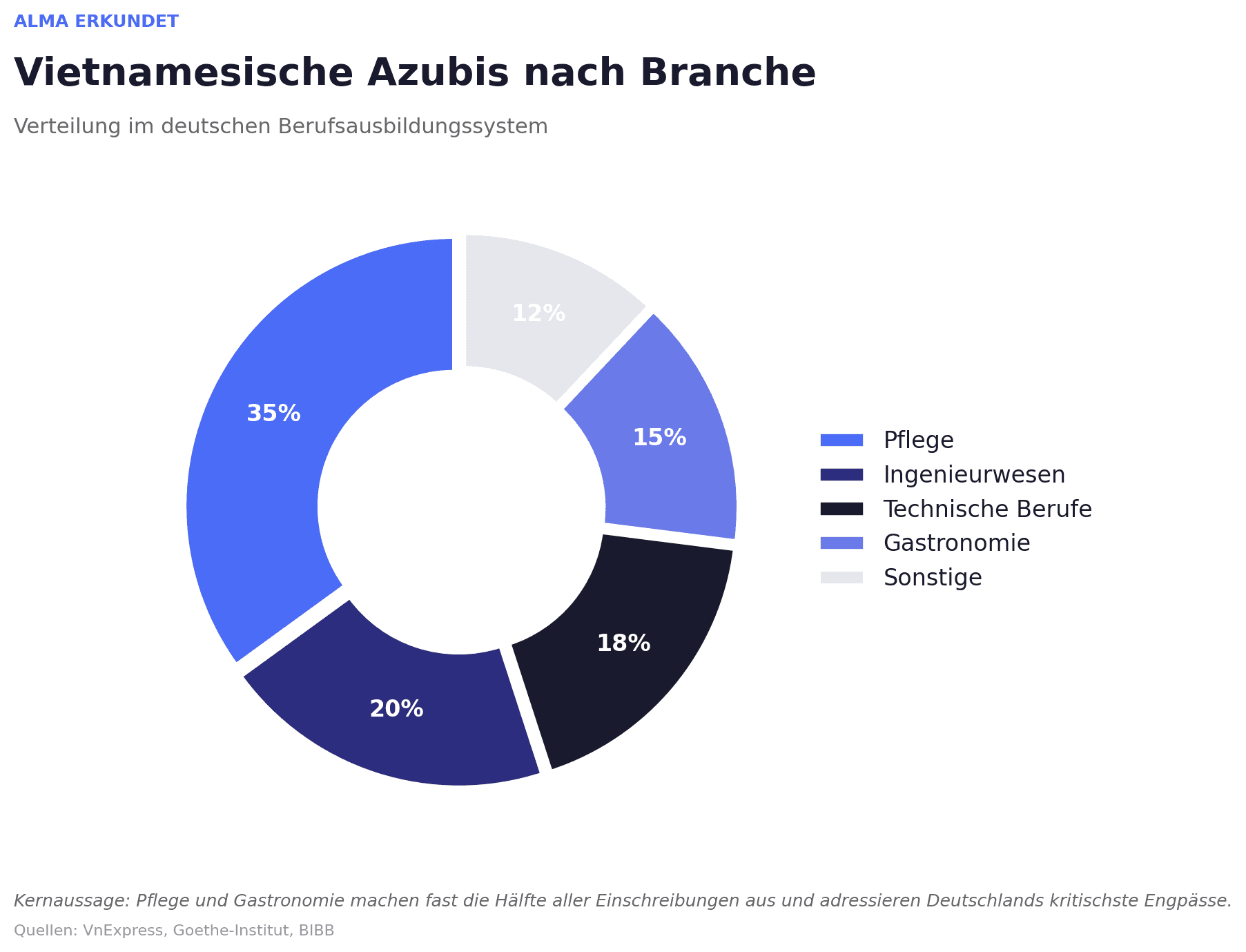
German vocational schools actively seek Vietnamese students and praise their diligence, academic performance, and strong work ethic. Employer satisfaction is high, and the Goethe-Institut has found that Vietnamese trainees are consistently among the most reliable high performers in the system.
Why vocational training is the smartest path
For Vietnamese talent, Germany's dual training system offers an exceptionally efficient path to a stable career. Unlike the academic route, vocational training completely eliminates tuition fees and pays a salary from day one. Trainees earn between 800 and 1,600 euros per month during training and obtain a German vocational qualification that opens the door to long-term employment and permanent residence.
One key reason why 80% of Vietnamese students prefer vocational training to university is this economic structure. The financial risk is low, the career prospects are strong, and the path to permanent settlement is clear.
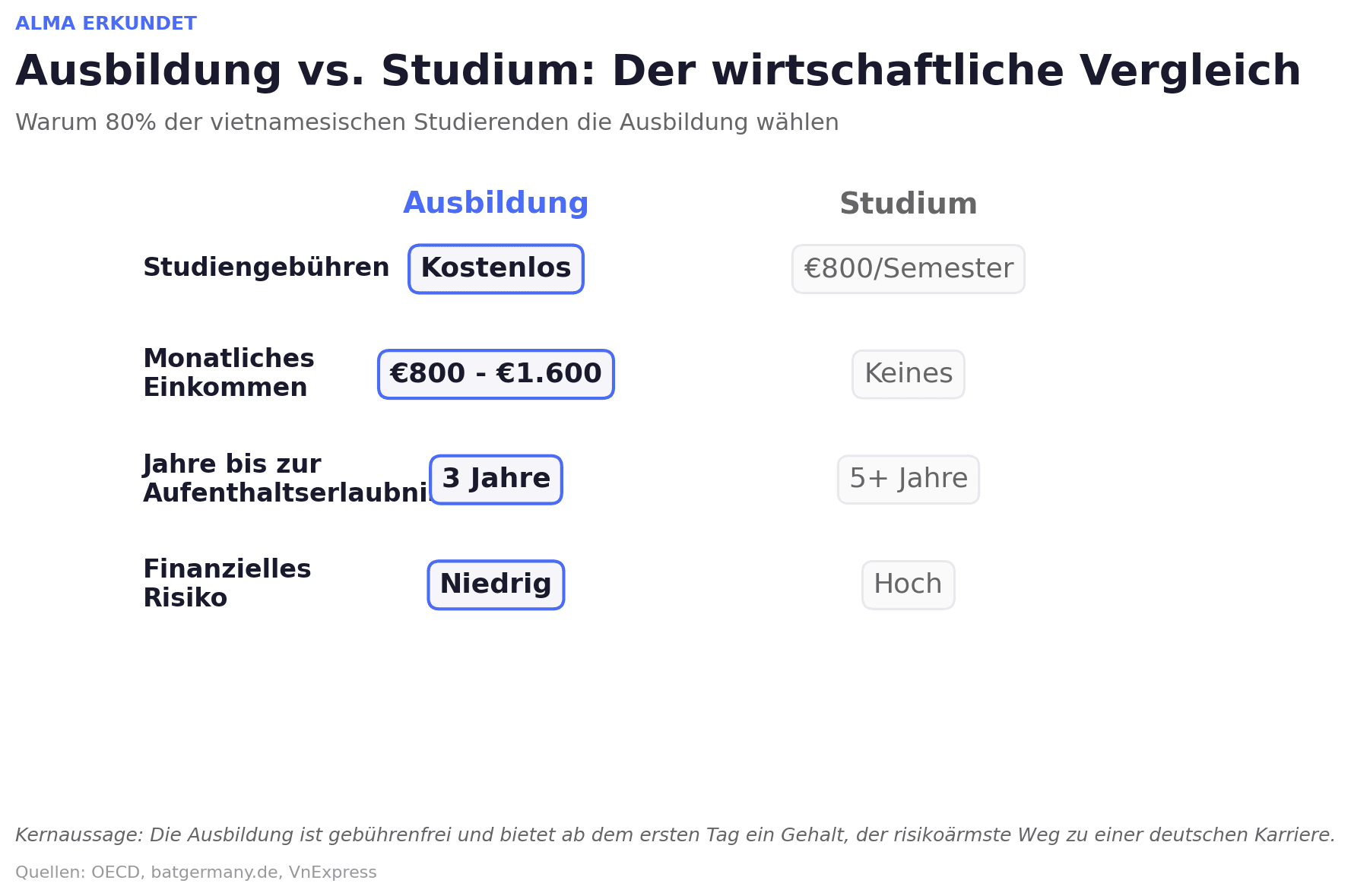
For employers, this means access to candidates who are genuinely interested in staying. The pay structure of vocational training creates a natural filter for commitment, and the dual model of classroom instruction and hands-on practice produces graduates who are ready from day one.
The Problem: What Happens When Recruitment Goes Wrong
Fake language certificates
Successful participation in the German vocational training system requires real B1 or B2 German skills. All classes and all exams are conducted exclusively in German. More than 90% of the companies involved in training confirm that sufficient language skills are essential for completing the program.
Nevertheless, more and more trainees are arriving with official certificates but without the actual language abilities. Private agencies in Vietnam have built a market for fake language certificates, in some cases with ties to organized crime networks. The Goethe-Institut has publicly warned about the extent of this problem.
Debt and exploitation
These same agencies charge fees of up to 20,000 euros to handle the visa, language test, and contract process. Young applicants end up heavily in debt, and when they arrive in Germany without the necessary language skills, they face a hopeless situation.
Vocational schools in Berlin have reported that up to one-third of enrolled Vietnamese trainees have disappeared from classes. These individuals are often pushed into illegal or precarious work in the shadow economy in order to repay their debts.
What this means for employers
For German companies, the consequences are real. A trainee who drops out in the first year means a complete loss of the investment in recruitment, onboarding, and training. It disrupts workforce planning and undermines confidence in international hiring as a strategy.
The key insight: These failures are not caused by lack of talent or lack of motivation. They result from a recruitment process that prioritizes volume over quality and allows unprepared candidates to enter a system they cannot handle.
What fair recruitment actually looks like
The data are clear: when Vietnamese trainees come to Germany through structured, government-vetted programs with real language preparation and follow-up support, the results are excellent.
Real language proficiency: B2 level, verified by independent tests, not by purchased certificates.
Transparent costs: No hidden fees, no debt bondage. The total costs are disclosed upfront.
Cultural and professional preparation: Candidates receive realistic expectations about German work culture and the requirements of their profession.
Ongoing follow-up support: Mentoring, cultural coaching, and regular check-ins with trainees and employers over 12 to 24 months.
Structured matching: Candidates are placed based on genuine fit with the employer's team, culture, and operational requirements.
What this means for German employers
If you as a German employer are considering international recruitment, the evidence is clear. Vietnamese talent is one of the strongest available sources of committed, high-performing trainees for your company.
However, the quality of the outcome depends entirely on the quality of the process. What you should look for in a recruitment partner:
Independent language verification: Does the partner verify language skills through independent tests or rely solely on certificates?
Transparent fee structure: Can the partner explain exactly what the candidate pays, and is that amount reasonable?
Preparation before departure: Does the partner invest in cultural and professional preparation before the candidate arrives?
Follow-up support: Does the partner remain involved after placement, or disappear after contract signing?
Verifiable retention rates: Can the partner provide real retention data from previous placements?
The companies that benefit most from international recruitment are those that treat it as a structured, long-term investment rather than a quick fix for an unfilled position.
About this report
This is the first in a series of research publications by Alma Recruiting, based on publicly available data, government reports, and academic research, to provide German employers with evidence-based insights into fair international recruitment.